
Stylish Hinged & Sliding Security Doors Guide
Your front door is more than just an entrance to your home—it’s the primary barrier between your family and potential threats. In Australia, where property crime remains a concern and climate extremes demand durable solutions, choosing the right security door is one of the most important decisions you’ll make as a homeowner. At P&D Security Shutters, we understand that security doors represent a significant investment in your property’s protection, comfort, and value.
This comprehensive guide explores the two main categories of security doors available to Australian homeowners: hinged security doors and sliding security doors. We’ll examine the various types within each category, their specific applications, compliance standards, and the factors that should influence your selection. Whether you’re securing a new build, upgrading an existing property, or responding to security concerns, this guide provides the knowledge you need to make an informed decision.
Understanding Security Door Fundamentals
Before diving into specific types, it’s essential to understand what makes a door a genuine “security door” rather than simply a decorative screen door with locks.
Australian Standards for Security Doors
Legitimate security doors in Australia must comply with AS 5039-2008 (Security screen doors and window grilles) or AS 5040-2016 (Security screen doors and security window grilles – enhanced protection). These standards define rigorous testing protocols including:
- Impact resistance: Withstanding strikes from heavy implements
- Jemmy resistance: Resisting prying tools attempting to force entry
- Shear resistance: Preventing cutting through mesh or bars
- Pull resistance: Resisting pulling away from frames
- Probe resistance: Preventing small tools from manipulating locks through mesh
Products meeting these standards display certification labels indicating compliance level. When selecting security doors, always verify Australian Standards certification—it’s your assurance that the door has been independently tested and proven effective.
Key Components of Quality Security Doors
Regardless of type, effective security doors share common elements:
- Heavy-gauge frames: Typically 1.6mm to 2.0mm thick steel or aluminium
- Quality mesh or infill: Stainless steel mesh, perforated aluminium, or steel bars
- Multi-point locking systems: Three or more locking points engaging the frame
- Reinforced hinge areas: Preventing hinge pin removal or frame separation
- Tamper-resistant fixings: Security screws requiring specialized tools for removal
Understanding these fundamentals helps you evaluate products and recognize quality when you see it.
Hinged Security Doors: Traditional Protection with Modern Engineering
Hinged security doors represent the most common type installed on Australian homes. Operating like traditional doors with side-mounted hinges, they swing open on a vertical axis—typically outward to maximize interior space and provide emergency egress advantages.
Types of Hinged Security Doors
1. Steel Mesh Security Doors
Steel mesh security doors feature woven stainless steel wire mesh that provides security while maintaining visibility and airflow. This classic design remains popular across Australia for several compelling reasons.
Construction and Features: Steel mesh doors use marine-grade 304 or 316 stainless steel woven into a fine mesh, typically 0.9mm to 1.2mm wire diameter. The mesh is tensioned within a powder-coated steel or aluminium frame, creating a barrier that’s difficult to cut, tear, or penetrate. Modern mesh designs offer various weaves ranging from ultra-fine (nearly invisible from a distance) to heavier gauge security-focused patterns.
Advantages:
- Superior visibility: Clear sightlines outward while obscuring inward views
- Excellent ventilation: Allows maximum airflow for natural cooling
- Insect protection: Fine mesh prevents mosquitoes and other pests
- Versatile aesthetics: Available in numerous colours matching any home style
- Corrosion resistance: Stainless steel withstands coastal environments
Ideal Applications: Steel mesh doors excel in situations requiring ventilation and visibility. They’re particularly popular for front entrances where homeowners want to see visitors clearly, coastal properties where corrosion resistance is essential, and homes in tropical regions where airflow is prioritized. The mesh construction also makes them lighter than solid alternatives, reducing stress on hinges and frames.
Considerations: While steel mesh provides excellent security, it offers minimal privacy when interior lights are on during evening hours. The mesh can also show dust accumulation in high-traffic areas, requiring regular cleaning to maintain appearance.
2. Perforated Aluminium Security Doors
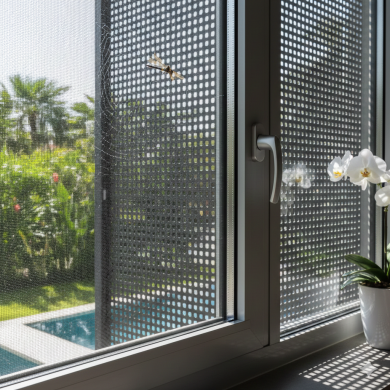
Perforated aluminium security doors feature solid aluminium panels with precision-cut hole patterns that balance security, visibility, and aesthetic appeal.
Construction and Features: These doors use 2.0mm to 3.0mm thick aluminium sheets with patterns of small holes—typically 3mm to 8mm in diameter—cut using laser or CNC technology. The perforation density varies by design, affecting both appearance and ventilation. The thicker material and solid construction create a more substantial barrier than mesh alternatives.
Advantages:
- Enhanced privacy: Perforations obscure interior views more effectively than mesh
- Superior strength: Solid aluminium resists cutting better than woven mesh
- Modern aesthetics: Contemporary designs complement architectural homes
- Low maintenance: Smooth surfaces clean easily and don’t trap dust like mesh
- Customizable patterns: Decorative perforation designs add visual interest
Ideal Applications: Perforated aluminium doors suit homeowners seeking privacy without sacrificing natural light and airflow. They’re particularly effective for bedrooms, bathrooms, or side entries where privacy matters. Urban properties in higher-density areas benefit from the obscured sightlines, while design-conscious homeowners appreciate the contemporary aesthetic that complements modern architecture.
Considerations: Perforated doors typically provide slightly less ventilation than mesh alternatives due to lower open area percentages. They’re also heavier, requiring robust hinges and occasionally door closers for smooth operation.
3. Decorative Security Doors
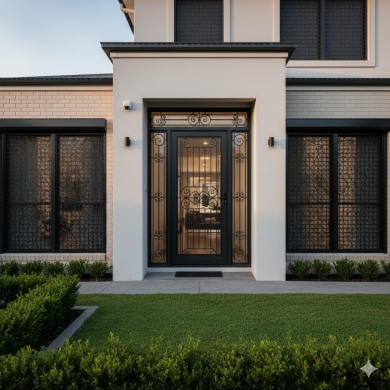
Decorative security doors combine security functionality with ornamental designs featuring laser-cut patterns, traditional scrollwork, or contemporary geometric motifs.
Construction and Features: These doors use similar materials to standard security doors—heavy-gauge steel or aluminium frames with mesh or solid infills—but incorporate decorative elements that transform them into architectural features. Designs range from heritage-inspired wrought-iron styles to ultra-modern abstract patterns, with options for powder coating in virtually any colour.
Advantages:
- Architectural enhancement: Complements and elevates home aesthetics
- Customization options: Personalized designs reflecting homeowner tastes
- Property value: Premium doors increase perceived and actual property value
- Neighbourhood compatibility: Heritage designs suit period homes in conservation areas
Ideal Applications: Decorative security doors excel on character homes, heritage properties, and designer residences where aesthetics matter as much as security. They’re popular for grand front entrances, prestige properties, and situations where maintaining architectural authenticity is important. Homeowners’ associations and heritage overlay areas often require decorative options that blend security with period-appropriate design.
Considerations: Custom decorative doors typically command premium pricing due to specialized manufacturing. Complex designs may also create additional cleaning challenges compared to simpler patterns. Consider maintenance requirements when selecting intricate designs for high-dust or coastal environments.
4. Triple Lock Security Doors
Triple lock security doors emphasize maximum security through advanced locking mechanisms featuring three or more locking points that engage simultaneously when the door is secured.
Construction and Features: These doors incorporate multi-point locking systems where turning a single key or handle engages locks at the top, middle, and bottom of the door frame. Some advanced systems feature five-point or even seven-point locking for ultimate security. The locks typically include deadbolts that extend deep into reinforced strike plates, creating an extremely secure closure that’s virtually impossible to force open.
Advantages:
- Maximum security: Multiple engagement points distribute force and prevent forcing
- Enhanced weather sealing: Multiple contact points improve draft and water resistance
- Insurance benefits: Premium locking often qualifies for insurance discounts
- Ease of use: Single action secures multiple points simultaneously
Ideal Applications: Triple lock doors suit high-security applications including homes in areas with elevated crime concerns, properties storing valuables, ground-floor apartments in multi-unit buildings, and situations where insurance requirements demand enhanced security. They’re also valuable for homeowners who travel frequently and want maximum peace of mind.
Considerations: Multi-point locking systems add weight and complexity, potentially requiring more maintenance than simpler alternatives. Professional installation is essential to ensure proper alignment and operation. The additional security comes at a premium price point compared to standard single-lock designs.
5. Fire-Rated Security Doors
Fire-rated security doors provide both security and fire resistance, meeting Australian fire safety standards for specific applications.
Construction and Features: These specialized doors incorporate fire-resistant materials and construction techniques that maintain structural integrity during fire exposure. They typically feature steel frames with fire-resistant core materials, intumescent seals that expand when heated to seal gaps, and fire-rated hardware. Certification levels range from 30 minutes to 120 minutes of fire resistance.
Advantages:
- Dual protection: Security and fire safety in one installation
- Compliance assurance: Meets Building Code of Australia requirements
- Escape route integrity: Maintains safe egress during emergencies
- Property protection: Compartmentalizes fire spread
Ideal Applications: Fire-rated security doors are essential for attached garages accessing homes, apartments and townhouses sharing common walls, properties with internal fire rating requirements, commercial premises with security and fire code obligations, and any application where building regulations mandate fire-rated barriers.
Considerations: Fire-rated doors require professional installation following strict guidelines to maintain certification. They cannot be modified or drilled after installation without potentially voiding fire ratings. These doors typically cost significantly more than standard security doors due to specialized materials and certification processes.
Sliding Security Doors: Space-Efficient Protection
Sliding security doors operate horizontally on tracks rather than swinging on hinges, making them ideal for locations where door swing would create obstacles or where space is limited.
Types of Sliding Security Doors
1. Standard Sliding Screen Security Doors
Standard sliding security doors are the most common type, designed to protect existing sliding glass doors while maintaining easy access to outdoor areas.
Construction and Features: These doors mount on top and bottom tracks, sliding parallel to the glass door they protect. Construction typically uses aluminium frames with stainless steel mesh or perforated infill. Quality units feature ball-bearing rollers for smooth operation, adjustable tracks for perfect alignment, and flush-mount locks that don’t protrude into the sliding path.
Advantages:
- No swing clearance required: Ideal for compact balconies, patios, and decks
- Seamless indoor-outdoor flow: Large opening widths facilitate entertaining and access
- Unobstructed views: Wide expanses of mesh or perforation maintain sightlines
- Weather protection: Shields glass doors from sun, rain, and debris
Ideal Applications: Standard sliding security doors excel for protecting sliding glass doors accessing alfresco areas, balconies in apartments and townhouses, pool areas where frequent access is required, and any location where door swing would obstruct furniture, plants, or movement paths. They’re particularly popular in Australian indoor-outdoor living designs where large openings connect living spaces to entertainment areas.
Considerations: Track maintenance is essential for smooth operation—dirt and debris must be cleaned regularly. Bottom tracks create slight trip hazards that require awareness. In extreme wind conditions, large sliding doors may experience wind pressure requiring wind locks or guides.
2. Stacking Sliding Security Doors
Stacking sliding security doors feature multiple panels that slide and stack to one or both sides, creating exceptionally wide openings from multi-panel door systems.
Construction and Features: These sophisticated systems typically incorporate two to four panels that slide on synchronized tracks. Panels can stack to one side (single-stack) or both sides (bi-parting) depending on configuration. Advanced systems feature minimal sightlines between panels, integrated locking that secures multiple panels simultaneously, and smooth operation despite substantial weight.
Advantages:
- Maximum opening width: Can create openings spanning several meters
- Flexible configuration: Open fully or partially as needed
- Architectural impact: Premium appearance enhances property appeal
- Seamless integration: Coordinates with stacker glass door systems
Ideal Applications: Stacking sliding doors suit large entertainment areas with full-width access requirements, luxury properties with expansive indoor-outdoor zones, commercial applications requiring wide secure openings, and architectural designs where maximizing opening width is a priority. They’re increasingly popular in high-end renovations and new builds featuring disappearing walls between interior and outdoor spaces.
Considerations: These complex systems require precise installation and represent significant investment. The weight of multiple panels demands robust track systems and regular maintenance. Panel stacking requires space at one or both ends of the opening—typically equal to the width of one panel multiplied by the number of panels stacking at each end.
3. Cavity Sliding Security Doors
Cavity sliding security doors disappear into wall cavities when opened, providing security without visible door presence when access is open.
Construction and Features: These doors slide into a pocket built within the wall cavity, typically constructed during building or renovation. The cavity accommodates the door’s full width, allowing it to completely disappear from view. Installation requires specialized cavity sliders, available as kits including track systems, frames, and cavity linings.
Advantages:
- Maximum space efficiency: No door visible when open
- Clean aesthetics: Eliminates visual clutter of doors
- Accessibility: Ideal for wheelchair and mobility aid access
- Thermal zoning: Creates flexible room divisions without permanent walls
Ideal Applications: Cavity sliding security doors excel in compact spaces where any door presence would obstruct function, accessibility requirements where wide clear openings without obstacles are essential, open-plan designs allowing flexible space division, and modern minimalist aesthetics where visual simplicity is prioritized. They’re popular for internal security doors separating zones within homes, particularly in multi-generational housing.
Considerations: Cavity sliders must be planned during construction or require significant renovation to retrofit. Wall cavities reduce available space in adjacent rooms or may require building out walls. Access to mechanisms for maintenance requires planning. These installations are significantly more complex and expensive than surface-mounted alternatives.
4. Pet-Friendly Sliding Security Doors
Pet-friendly sliding security doors incorporate integrated pet doors allowing animals to move freely between indoor and outdoor spaces while maintaining security.
Construction and Features: These specialized doors feature pet flaps built into the lower section, sized for cats, small dogs, medium dogs, or large dogs depending on specification. Quality pet doors include lockable flaps for security when not in use, magnetic or electronic closures preventing drafts, and durable construction withstanding enthusiastic pets. The security door maintains full certification despite the pet door inclusion.
Advantages:
- Pet freedom: Animals access outdoor areas independently
- Convenience: No need to constantly open doors for pets
- Security maintained: Pet door sizes prevent human access
- Energy efficiency: Flaps seal when closed, unlike leaving full doors open
Ideal Applications: Pet-friendly sliding doors suit active pet owners who want animals to enjoy outdoor access, homes with secure yards or balconies where pet safety is assured, situations where frequently opening doors is impractical, and households where pets have regular outdoor toilet areas. They’re particularly valuable for working families where pets might otherwise be confined indoors all day.
Considerations: Pet door openings may allow unwanted wildlife entry in some areas—particularly in regions with possums, snakes, or other animals similar in size to pets. Electronic pet doors with RFID collars solve this but add complexity and cost. Pet doors may slightly reduce overall door security ratings depending on size and construction.
5. Heavy-Duty Commercial Sliding Security Doors
Heavy-duty commercial sliding security doors provide enhanced security for retail, industrial, and high-risk residential applications.
Construction and Features: These robust doors feature heavier gauges of steel (often 2.5mm or thicker), reinforced locking mechanisms with multiple engagement points, tamper-resistant roller systems, and construction meeting enhanced AS 5040 standards. Panels often incorporate solid sections or minimal perforation for maximum strength. Commercial-grade automation options are commonly available.
Advantages:
- Superior security: Enhanced protection for high-value assets
- Durability: Withstands commercial use and abuse
- Automation ready: Can integrate with access control systems
- Insurance compliance: Meets stringent insurance requirements
Ideal Applications: Heavy-duty sliding doors suit retail shopfronts requiring after-hours security, warehouses and industrial facilities, home businesses storing valuable inventory or equipment, and luxury residences in high-crime areas requiring enhanced protection. They’re essential where standard residential security doors don’t provide adequate protection.
Considerations: These doors represent significant investment both in product cost and installation complexity. Their weight requires industrial-grade track systems and potentially automated operation for practical daily use. Aesthetics tend toward functional rather than decorative, which may not suit all residential applications.
Material Considerations for Security Doors
Understanding material properties helps you select doors suited to your specific environment and requirements.
Aluminium vs. Steel Frames
Aluminium frames offer excellent corrosion resistance, making them ideal for coastal properties. They’re lighter, reducing stress on tracks and hinges, and available in numerous powder-coated colours. Aluminium naturally resists rust and requires minimal maintenance. However, aluminium is slightly less strong than steel of equivalent gauge.
Steel frames provide maximum strength and impact resistance. They’re preferred for high-security applications where ultimate protection is paramount. Modern powder coating protects steel from corrosion, though edges and scratches may eventually rust if not properly maintained. Steel doors typically cost less than aluminium equivalents but weigh more.
For most Australian applications, quality aluminium with appropriate gauges provides excellent security while offering superior longevity in our harsh coastal climate.
Mesh Options and Security Ratings
Stainless steel mesh remains the gold standard for security screens. Grade 304 stainless suits most applications, while Grade 316 marine stainless provides enhanced corrosion resistance for harsh coastal environments. Mesh gauge affects both security and visibility—heavier gauges provide better protection but slightly reduced sightlines.
Perforated aluminium offers superior privacy and a contemporary aesthetic. The solid material is harder to cut than woven mesh, providing excellent security. However, perforation patterns affect ventilation—smaller, more densely packed holes offer better privacy but reduced airflow.
Locking Systems and Security Hardware
Modern security doors incorporate sophisticated locking systems far superior to traditional keyed locks. Multi-point locks are standard on quality products, engaging three to seven points simultaneously. Deadlocks provide additional security, preventing lock manipulation even if the key cylinder is compromised. Keyed-alike systems allow one key to operate multiple doors throughout your property, balancing security with convenience.
Triple-locking mechanisms are increasingly popular, featuring deadlocks at top, middle, and bottom that engage with a single key turn. Some premium systems include internal thumb-turn operation allowing easy exit without keys—valuable for emergency egress while maintaining external security.
Climate Considerations for Australian Conditions
Australia’s diverse climate zones demand tailored security door specifications.
Tropical and Subtropical Regions
Queensland and Northern Territory properties face intense UV exposure, high humidity, and cyclone risk. Security doors for these regions should feature:
- Cyclone-rated construction meeting AS/NZS 1170.2 wind load requirements
- Maximum ventilation utilizing fine mesh or high-perforation designs
- UV-stable powder coating preventing fade and deterioration
- Corrosion-resistant materials withstanding humidity
Coastal Environments
Properties within 5 kilometers of coastline face accelerated corrosion from salt spray. Specify:
- Marine-grade stainless steel mesh (Grade 316)
- Quality powder coating with marine-specific formulations
- Stainless steel hardware including hinges, locks, and fasteners
- Regular maintenance including freshwater washing to remove salt deposits
Bushfire-Prone Areas
Properties in bushfire zones may require doors meeting AS 3959 Bushfire Attack Level (BAL) ratings. While security doors aren’t typically the primary bushfire barrier (that’s the exterior door), in some configurations they contribute to ember protection and may need BAL certification. Consult with building surveyors regarding specific requirements for your property’s BAL rating.
Installation Considerations
Professional installation is non-negotiable for security doors. Improper installation compromises security, voids warranties, and may create safety hazards.
Critical Installation Elements
Frame preparation ensures doors fit perfectly within openings without gaps that compromise security or weather resistance. Fixing methods must use appropriate fasteners into solid structure—not just architraves or trim. Alignment is critical for smooth operation, particularly for sliding doors where misalignment causes binding and accelerated wear.
Weather sealing around hinged doors prevents drafts and water penetration while maintaining smooth operation. Emergency egress compliance ensures doors meet Building Code requirements for emergency exit, particularly for bedrooms and other habitable spaces.
DIY vs. Professional Installation
While DIY installation might seem cost-effective, security doors demand expertise that most homeowners lack. Professional installers understand:
- Building codes and compliance requirements
- Structural considerations and fixing methods
- Correct measurements accounting for operation clearances
- Hardware adjustment and calibration
- Warranty requirements (most manufacturers require professional installation)
The modest cost savings of DIY installation aren’t worth the risk of compromised security, voided warranties, and potential injury from improper installation.
Maintenance for Longevity
Quality security doors properly maintained will provide decades of reliable service.
Regular Maintenance Tasks
Monthly: Wash down with mild detergent and water, particularly important for coastal properties. Inspect mesh for damage. Lubricate hinges and locks with appropriate lubricants.
Quarterly: Clean and lubricate sliding tracks. Check and adjust door alignment. Inspect weather seals for wear. Test all locking points for proper engagement.
Annually: Professional inspection and service, particularly for complex multi-point locking systems. Check frame fixings. Assess powder coating condition. Replace worn components.
Common Issues and Solutions
Doors becoming difficult to open: Usually caused by dirt in tracks (sliding) or binding hinges (hinged). Clean tracks thoroughly or adjust hinge screws.
Locks not engaging properly: Often indicates door sagging or frame movement. Professional adjustment restores alignment.
Mesh damage: Small tears can sometimes be repaired, but extensive damage requires mesh replacement to maintain security certification.
Making Your Selection
Choosing between hinged and sliding security doors, and then selecting the specific type, depends on multiple factors:
Space constraints: Hinged doors require swing clearance; sliding doors need track space and panel stacking room.
Usage patterns: High-traffic openings benefit from durable hinged doors; entertainment areas suit wide-opening sliding configurations.
Security requirements: Both types can achieve high security ratings when properly specified and installed.
Aesthetic preferences: Decorative hinged doors make statements; contemporary sliding doors complement modern architecture.
Budget considerations: Standard hinged doors are typically most economical; specialized sliding systems command premium pricing.
Conclusion: Investing in Comprehensive Security
Security doors represent one of the most effective investments you can make in your property’s protection. Whether you choose hinged or sliding configurations, modern security doors deliver far more than simple break-in deterrence. They enhance comfort through ventilation and insect protection, increase property value through aesthetic appeal, improve energy efficiency, and provide peace of mind that your home has quality protection.
At P&D Security Shutters, we help Australian homeowners navigate the extensive range of security door options to find solutions perfectly matched to their properties, priorities, and budgets. Our experienced team understands the unique requirements of Australian conditions—from cyclone-prone coasts to bushfire zones—and ensures every installation meets or exceeds relevant standards while delivering years of reliable service.
Security is too important to leave to chance. Invest in quality security doors professionally installed, and enjoy the confidence that comes from knowing your home is properly protected.
Ready to enhance your home’s security? Contact P&D Security Shutters today for a comprehensive assessment of your property’s security door requirements. Our team provides expert guidance on hinged and sliding door options, professional installation, and ongoing support. Protect what matters most with security doors engineered for Australian homes.
Call us today or visit our showroom to see our complete range of security door solutions.
Add comment